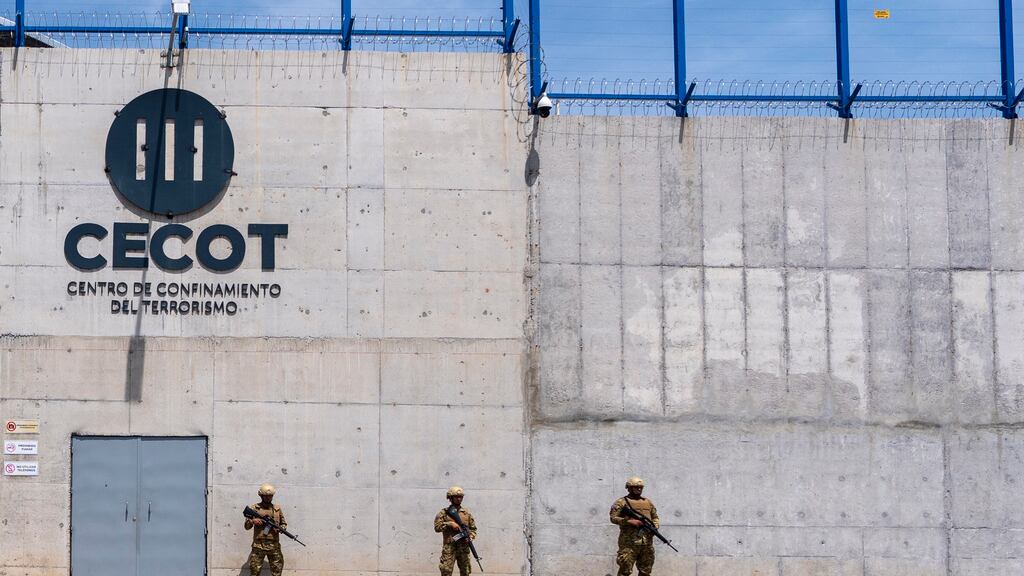
On Saturday, the Supreme Court blocked, for now, the deportations of any Venezuelan detained in North Texas under an 18th-century war law.
In a brief order, the court ordered the Donald Trump administration not to deport the Venezuelans detained at the Bluebonnet Detention Center “until further order from this court.”
PUBLICIDAD
Justices Clarence Thomas and Samuel Alito dissented.
The Supreme Court acted in response to an emergency appeal from the American Civil Liberties Union, which argued that immigration authorities appeared to be seeking to resume deportations under the 1798 Alien Enemies Act.
The Supreme Court had stated in early April that deportations could only proceed if those to be deported had the opportunity to present their arguments before the court and were given “reasonable time” to challenge their pending deportations.
“We are deeply relieved that the Court has temporarily blocked the deportations. These individuals were at imminent risk of spending the rest of their lives in a brutal Salvadoran prison without ever having had due process,” said ACLU lawyer Lee Gelernt in an email.
On Friday, two federal judges refused to intervene as the men’s lawyers launched a desperate legal campaign to avoid their deportation, even though one judge stated that the case raised legitimate concerns.
On Saturday morning, the Fifth Circuit Court of Appeals in the U.S. also refused to issue an order protecting detainees from deportation.
The administration is expected to quickly return to the Supreme Court in an effort to persuade the judges to lift their temporary order.
The ACLU had already filed a lawsuit to block the deportations of two Venezuelans detained at the Bluebonnet facility and had requested an order prohibiting the expulsion of any immigrant from the region under the Foreign Enemies Act.
In an emergency presentation on Friday morning, the ACLU warned that immigration authorities were accusing other Venezuelan men detained there of being members of the Tren de Aragua gang, which would make them subject to President Donald Trump’s use of the law.
The law has only been invoked three times before in the history of the United States, most recently during World War II to intern American civilians of Japanese descent in internment camps. The Trump administration argued that it gave them the authority to quickly deport immigrants they identified as gang members, regardless of their immigration status.
Following the unanimous order from the Supreme Court on April 9th, federal judges in Colorado, New York, and southern Texas quickly issued orders prohibiting the deportation of detainees under the AEA until the government provides a process for them to present claims in court.
But no similar order had been issued in the Texas area that covers Bluebonnet, which is located 24 miles north of Abilene at the northern end of the state.
Federal District Judge James Wesley Hendrix, appointed by Trump, refused this week to prevent the government from deporting the two men identified in the ACLU lawsuit, as the Immigration and Customs Enforcement (ICE) presented sworn statements that they would not be deported immediately. He also opposed issuing a broader order banning the deportation of all Venezuelans in the area under the law, arguing that deportations had not yet begun.
But the ACLU’s presentation on Friday included sworn statements from three different immigration lawyers who claimed that their clients at Bluebonnet received documentation indicating that they were members of the Aragua Train and could be deported on Saturday. In one case, immigration lawyer Karene Brown stated that her client, identified by their initials, was asked to sign the documents in English, even though they only spoke Spanish.
“ICE informed FGM that these documents came from the president and that he would be deported even if he did not sign them,” Brown wrote.
Gelernt declared at a hearing on Friday night before District Judge James E. Boasberg in Washington, D.C., that the government initially moved the Venezuelans to their immigration center in South Texas for deportation. However, since a judge banned deportations in that area, they have been channeled to the Bluebonnet center, where no such order exists. He added that witnesses reported that the men were being loaded onto buses on Friday night to be taken to the airport.
Faced with Hendrix’s refusal to accept the ACLU’s request for an emergency order, the group turned to Boasberg, who initially halted deportations in March. The Supreme Court ruled that deportation orders could only come from judges in jurisdictions where the immigrants were detained, leaving Boasberg powerless on Friday.
“I understand everything you’re saying,” Boasberg told Gelernt. “I just don’t believe I have the ability to do anything about it.”
This week, Boasberg determined that there is probable cause that the Trump administration committed criminal contempt by disobeying his initial deportation ban. He was concerned that the document handed out by ICE to detainees did not clarify their right to challenge their deportation in court, which he believed the Supreme Court required.
Drew Ensign, a lawyer from the Department of Justice, disagreed, stating that individuals scheduled for deportation would have a minimum of 24 hours to challenge their deportation in court. He added that there were no flights scheduled for Friday night and that he was unaware of any flights for Saturday, but the Department of Homeland Security stated that they reserved the right to deport individuals at that time.
ICE said they would not comment on the litigation.
Also on Friday, a judge in Massachusetts made permanent his temporary ban on deporting immigrants who have exhausted their appeals to countries other than their countries of origin unless they are informed of their destination and given the opportunity to object if they would face torture or death there.
Some Venezuelans subject to Trump’s Foreign Enemies Law have been sent to El Salvador and housed in its notorious main prison.